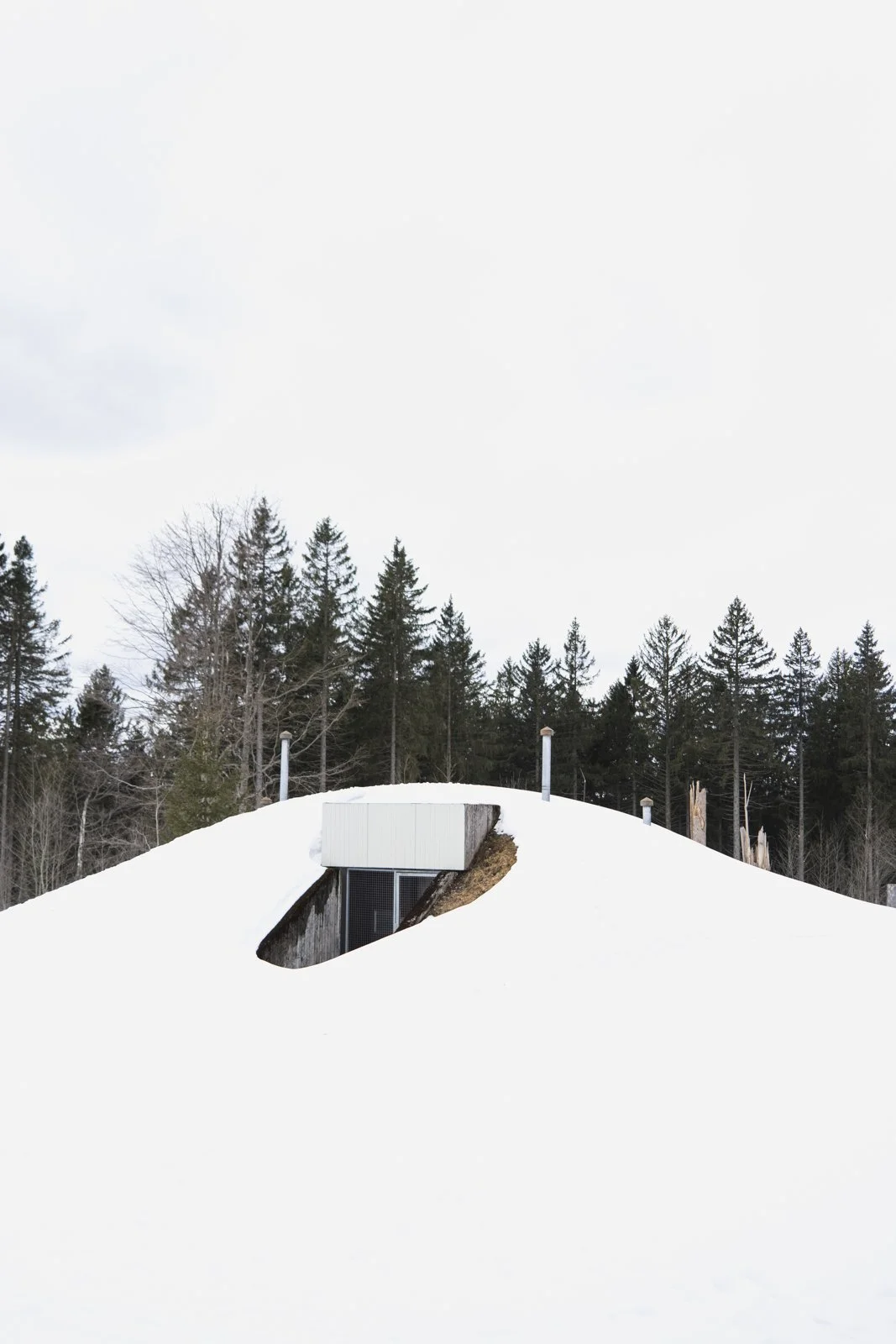
Todtnauberg: Inherited Fault Lines

come from there. Or not far from it. So: not innocent.
The forest Heidegger looked at — I breathed it.
Not by choice. By origin.
You might think Todtnauberg is just a photo series. An aesthetic proposition among others. That would be a mistake. Todtnauberg grows out of a deep unease: what History has left behind in our landscapes, our families, our habits of seeing. That heavy residue, often unspoken, which Europe prefers to bypass rather than confront — even though it always returns, under new names, new masks.
I was born a few kilometres from Todtnauberg. This place is no abstraction; it is my ground, the first horizon of my gaze. Returning there is not a walk. It is returning to an intimate territory where History has never stopped working on memory — mine, and that of so many others. A home — but a fractured one.

Everything begins with that cabin in the Black Forest. After the Shoah, Heidegger welcomes Paul Celan there. A philosopher who dodges confession. A surviving poet waiting for a word that will never come. A tiny yet decisive scene: one of the greatest thinkers of the twentieth century refuses to acknowledge his complicity. That is the original crack. The denial around which Europe continues to circle.
From that fracture, Todtnauberg unfolds. An open-air investigation into a European memory that, beneath its calm surface, remains a mined territory. The photographed landscapes — Verdun, Amsterdam, the Black Forest — are not places. They are archives. Evidence. Crime scenes whose wounds nature has covered but never healed.
One reading guided me throughout this inquiry: Les Origines by Reiner Schürmann. A testament-book, written under the urgency of approaching death. Schürmann dismantles the illusion of “native soil,” of clear lineage, of origin as reassurance. He shows that origin is a wound, not a myth. A fracture, not a foundation. Reading him, I understood that my own origin — Todtnauberg — belongs to that order: not a root, but a shard.

In the series, an almost abstract patch of ground photographed in Verdun speaks for itself: the industrialisation of death, millions of lives reduced to numbers and swallowed by mud. Later, in Amsterdam, after visiting Anne Frank’s house, a simple strand of my daughter’s hair on a white sheet summons the Shoah into the most ordinary gesture. Memory does not warn: it erupts.
And then there is this obstinate return: the portrait of my grandfather. Swept up by the currents of Nazism, like so many ordinary men whom History required in order to become possible. This figure reappears in Todtnauberg as a dark leitmotif, echoing Celan’s Todesfuge: “der Tod ist ein Meister aus Deutschland.”

Celan’s “Master from Germany” — that is him. My grandfather. Not a caricatured perpetrator, but an ordinary man. And it is precisely that ordinariness — yes — that makes one tremble.
Todtnauberg is this: refusing to look away. Accepting that history does not stop in books. That it colonises families, gestures, the folds of language. That it also shapes how we do — or do not — recognise the rise of today’s dangers.
Because what is returning now is clear: authoritarianism settling quietly, the re-entry of dehumanisation into public language, state violence justified in the name of security, militarisation presented as inevitability. A familiar sound. A cycle repeating.
The images of Todtnauberg offer no lesson. They open a space. A place where we may still ask: what, in this landscape, is coming back? And above all: what do we — each of us — do with our origins, our inheritances, this past that continues to look back at us?
It is the only question that matters. And it does not ask for comfort, but for courage: the courage to look at where our responsibility truly begins.