






Twelve Hours
TRANSIT , from Latin transire (“to go across, pass in, pass through”), from trans (“over”) + ire (“to go”)
Twelve Hours examines the suspension of time within a limited temporal frame, revealing how ordinary moments become charged with tension, vulnerability, and expectation.
Prints available · Contact for exhibitions and acquisitions
Prints & exhibition copies Available as limited editions: 40 × 50 cm and 60 × 80 cm. Piezography carbon inks on Hahnemühle Photo Rag 308g. Signed and numbered. Exhibition loans available on request. → matthias.koch@pm.me
One is not really there yet, and actually already gone again.
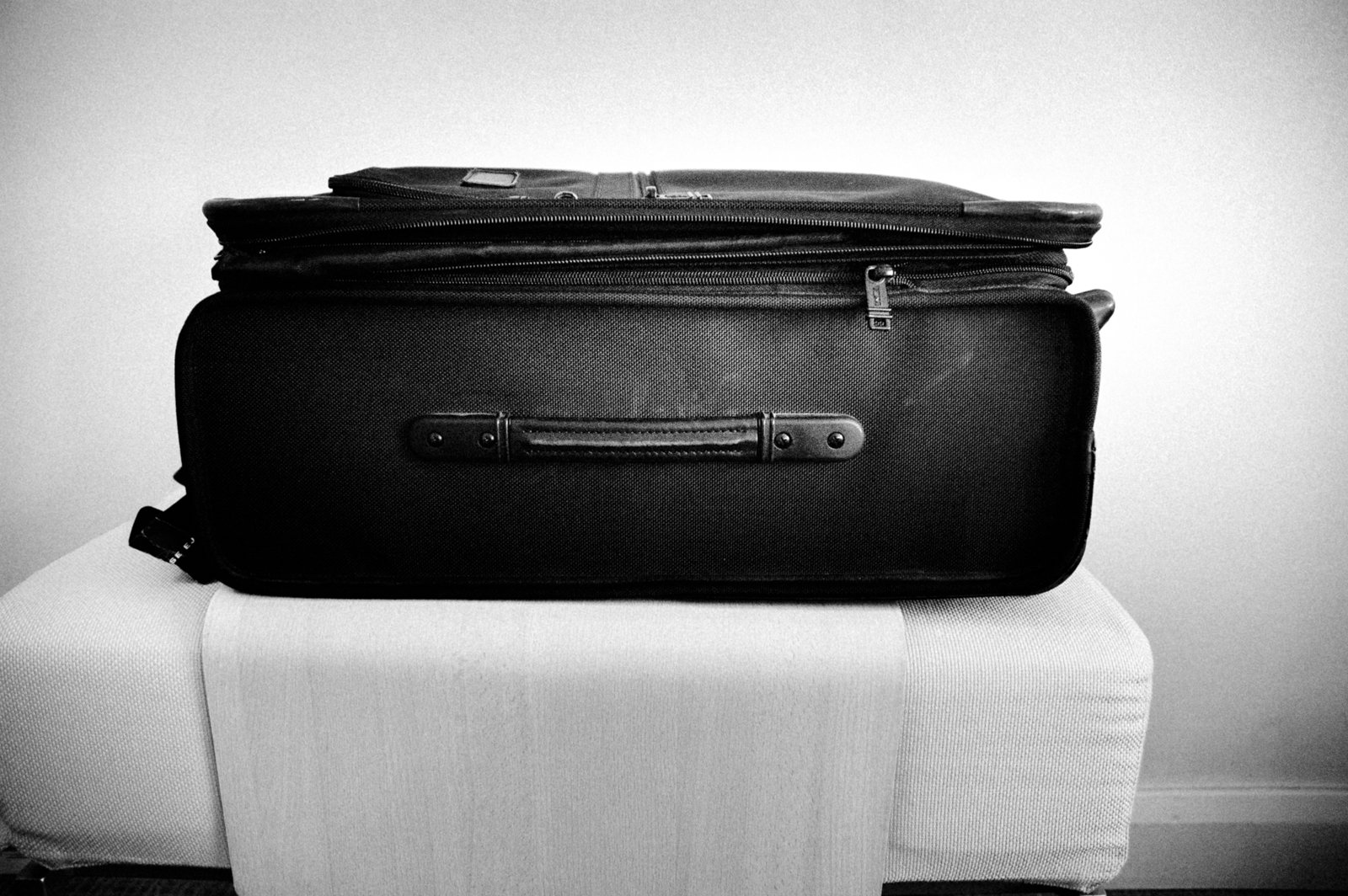
For years I traveled constantly — not as a photographer, but for work. Hotels in cities I could not name the next morning. Airport lounges where the time on the screen bore no relation to the time in my body. Anonymous bars where the only company was the sound of ice in a glass and the heavy stillness of a solitude that belongs to no one in particular. I lived in these spaces the way most people do: without seeing them. Places suspended in time and space, where one exists everywhere and nowhere at once.
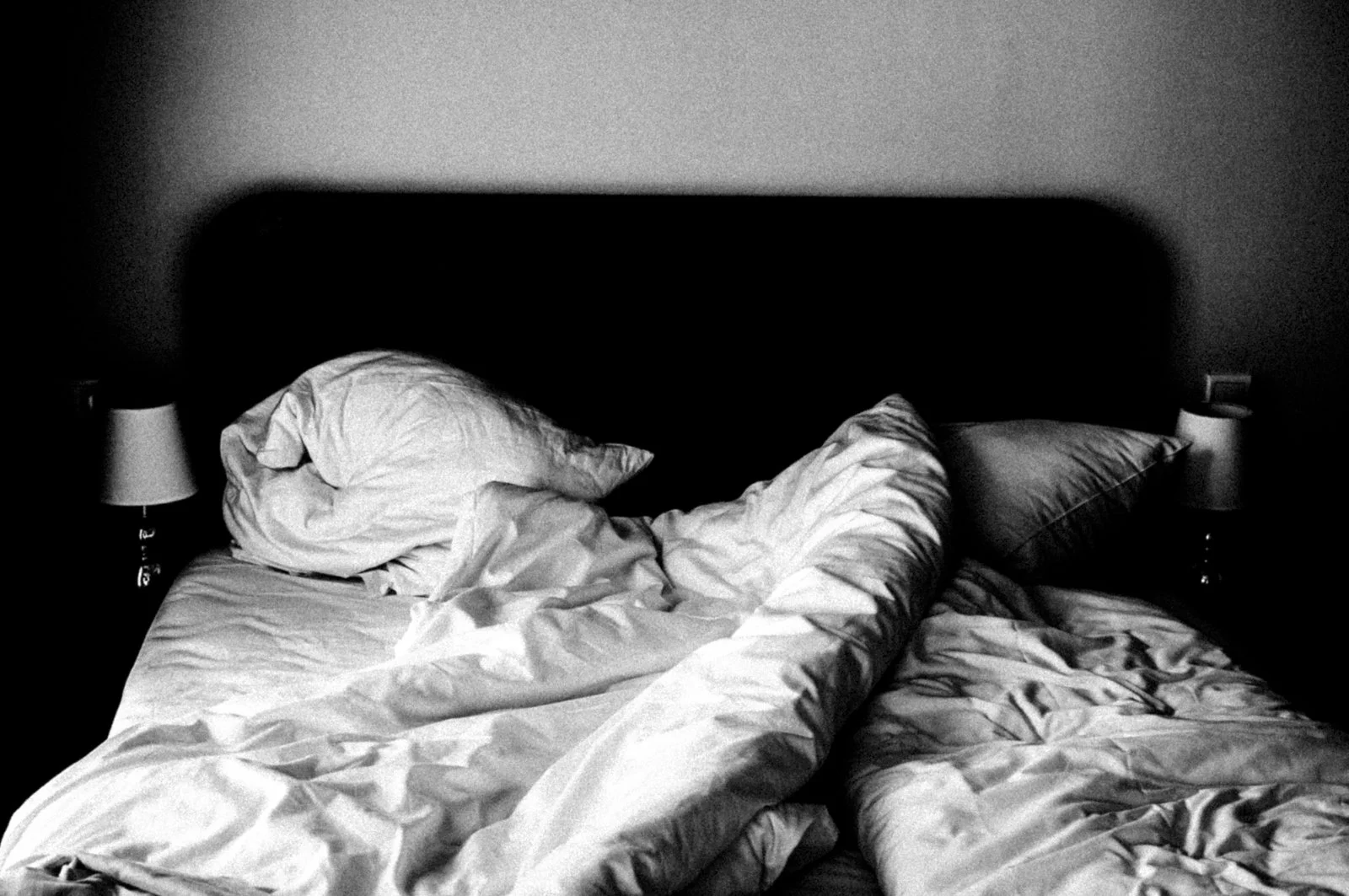
Then I began to photograph them. Not because they were interesting — they are not. Because they were true. Truer, in some ways, than the cities I was supposed to be visiting. The hotel room is what travel actually looks like when you strip away the narrative of discovery. It is a room. A lamp. A curtain that filters a light you cannot identify as dawn or dusk. A meal tray that tells you nothing about where you are. A nighttime cityscape seen from behind glass, belonging to someone else's life.
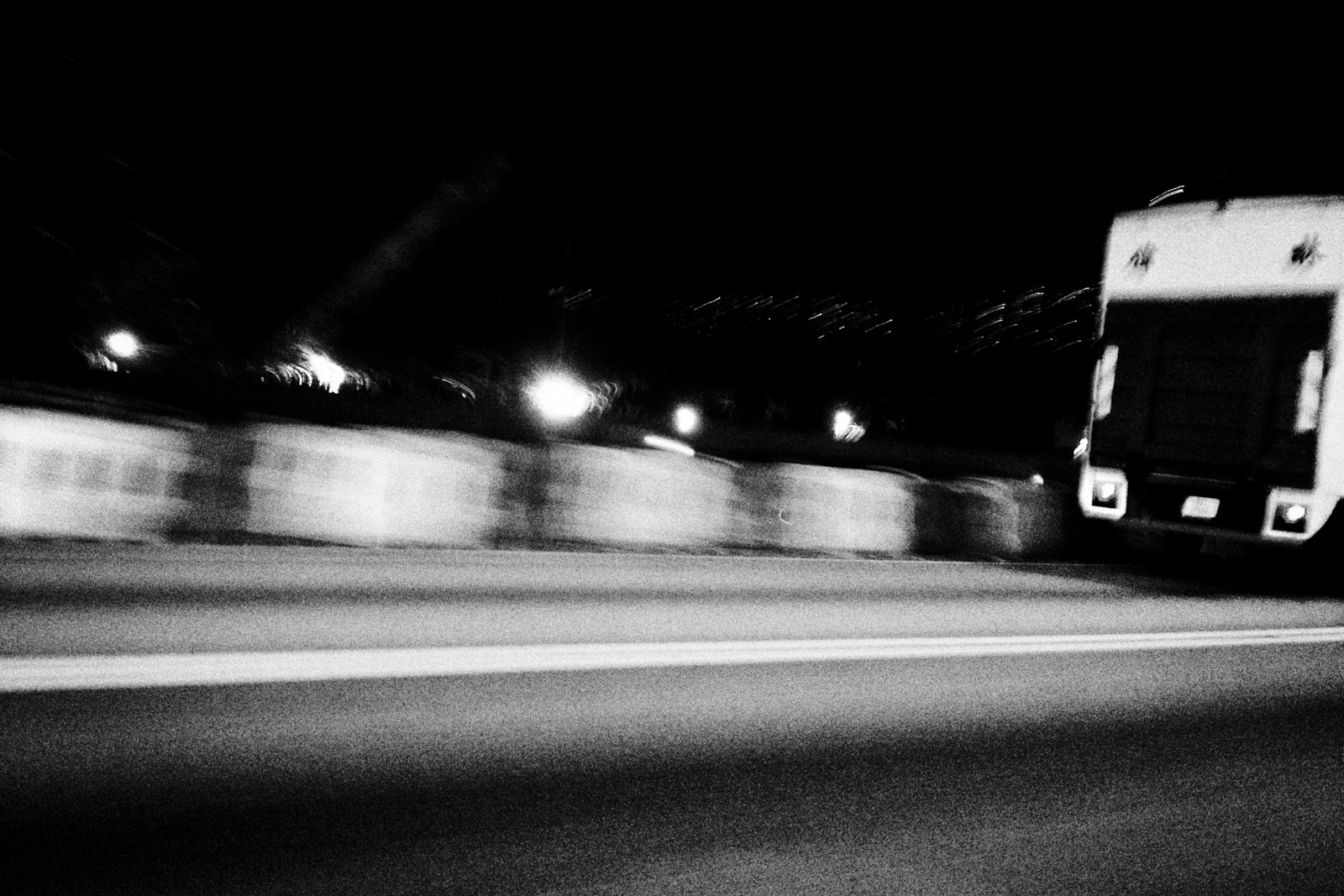
Twelve Hours takes its title from the span of a stopover — the duration between arrival and departure in which nothing is supposed to happen. But something does happen. Time, relieved of purpose, becomes palpable. The silence of an empty corridor at three in the morning is not the same silence as the one at noon. The body, unable to sleep, registers every surface — the harsh glare of artificial light casting sharp shadows on sterile walls, the sheen of a countertop, the soft veil of curtains dimming a bedside lamp. Ordinary details that, in the suspended hours of sleeplessness, transform into something else entirely — splinters of a state between states.
These are not portraits of solitude, though solitude is in them. They are photographs of suspension — of what it feels like to exist between two points, belonging to neither. The transit zone is a space without memory. No one has lived there. No one will remember having been there. Each image captures not a place, but a sensation: the unease of being out of sync, always caught between departure and arrival. Stolen moments in which time stretches and feels both insignificant and infinite — a mirror held up to our own sense of the fragility of the present, the fleetingness of passage.
I made these images in black-and-white because colour would have given them a specificity they do not possess. A yellow lamp, a blue carpet — these would locate the image in a particular hotel, a particular city. Black-and-white removes that anchor. What remains is the structure of the experience itself: artificial light, enclosed space, the absence of horizon. A condition shared by anyone who has spent a night in a room that is not home and will never be.
Twelve Hours is the smallest series I have made, and the most contained. It does not deal with history or territory. It deals with the body — alone, displaced, awake in a space designed for no one. It is a story of universal pauses, of places where we are left alone with ourselves — in waiting, in transit, always in the temporary. The photographic equivalent of jet lag: a misalignment between where you are and when you are, in which the present becomes strangely available, almost unbearable in its clarity.