Sergio Larrain, or the Image That Appears
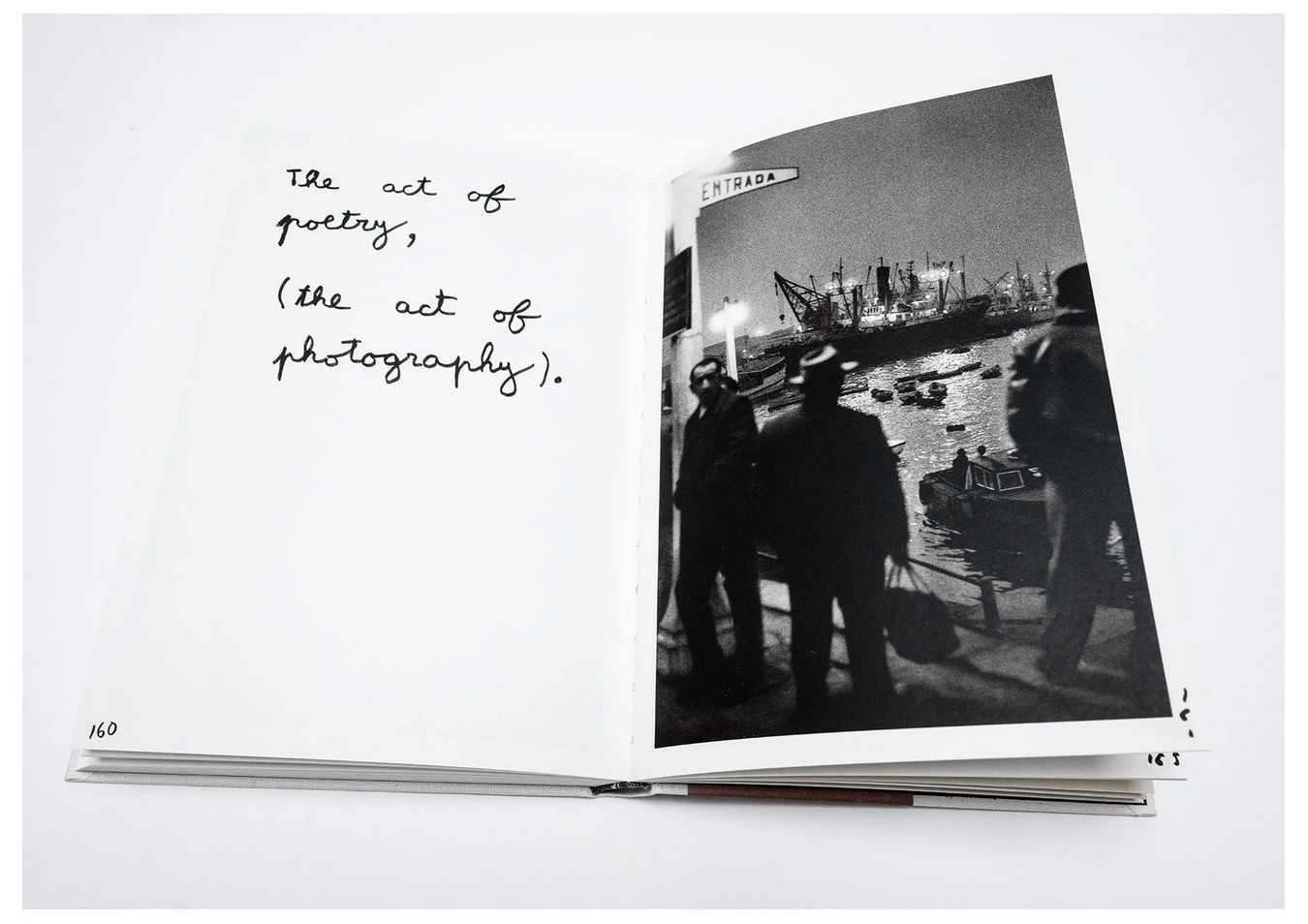
A phenomenology of wandering
One Wednesday in 1982, from his house in Tulahuén, in the Chilean precordillera, Sergio Larrain sits down to write to his nephew. He is fifty-one years old. Thirteen years earlier, he had set down his camera and chosen withdrawal. He lives without a telephone, divides his days between yoga, drawing, and meditation, and communicates with the outside world only by letter. Over the three decades that separate him from his death in 2012, he will exchange more than five hundred letters with his sole correspondent, Agnès Sire. The letter addressed that Wednesday to Sebastián Donoso, who wants to become a photographer, is among his most widely known. Read aloud by Donoso at the Catholic University of Chile in 2009, published in 2013 in the monograph edited by Sire and Xavier Barral, it has become one of the foundational texts of contemporary photographic thought.
What strikes one upon rereading it is that Larrain theorizes nothing. He describes. But his description, in its unadorned precision, says what another tradition — that of Continental phenomenology — had named in other words. Larrain does not cite Husserl, does not invoke Heidegger, has likely never opened Merleau-Ponty. And yet the letter to his nephew can be read as a phenomenology of photography written by someone who had practised it for thirty years. That is the reading I would like to propose here. But it presupposes that one first understand what Larrain had to leave behind in order to write it.
The Magnum misunderstanding
Sergio Larrain joined Magnum in 1959, at the invitation of Henri Cartier-Bresson himself, to whom he had shown his series on the street children of Santiago. He became a full member in 1961. For the young Chilean from a cultivated bourgeois family — his father an architect, the family home filled with Matisse and Cézanne — the agency represented the highest summit photography could offer. He moved to Paris, worked for Paris Match, Life, Du, took on assignments: the Sicilian mafia, which he photographed from within after befriending the capo Giuseppe Russo; the wedding of the Shah of Iran and Farah Diba; the Venice Film Festival; the Juan Fernández Islands.
Very quickly, something began to grate. On 5 June 1962, Larrain wrote a letter to Cartier-Bresson which, without breaking off, made the fundamental misunderstanding plain. He had tried, he wrote in substance, to adapt to the group in order to learn and to be published. But he wanted to return to what seemed serious to him. He spoke of markets, of money, of the disarray that overtook him. He said he wanted to find a path that would allow him once again to move at a more vital level. It is a gentle, almost embarrassed letter — but it announces everything to come.
The misunderstanding was not circumstantial. It was structural. Cartier-Bresson conceives of photography as a geometry of the instant — a coincidence to be caught. Larrain conceives of it as a meditation, as a state in which something can occur. Photojournalistic commissions demand that one go to where the event is to take place, return with saleable images, and meet the editorial calendar. That temporality is, for Larrain, alien to whatever makes an image possible. He begins to speak, in his letters, of lies. He returns to Chile. He collaborates with Pablo Neruda on the house at Isla Negra. He photographs less and less.
From Arica to Tulahuén
In 1968, Larrain meets Óscar Ichazo, a Bolivian philosopher and spiritual master who is gathering a community around himself in Arica, in northern Chile. Ichazo teaches a demanding syncretism — Sufism, Zen Buddhism, Gurdjieff, yoga, the enneagram — accompanied by guided psychotropic experiences and rigorous psychophysical practices. Larrain settles there in 1969 and stays for three years. During that period he breaks with Magnum, writes on ecology, takes LSD and peyote, practises yoga intensively. He photographs almost nothing. The break with Ichazo will come in 1972, against a backdrop of personal tensions: it is said that Larrain discovered the practices the master reserved for himself with the women of the group. He leaves Arica.
The following year, Pinochet's coup d'état overtakes Chile. Larrain, who had covered the golpe as a reporter, withdraws definitively. He settles first in Ovalle, then in the more remote house at Tulahuén, in the precordillera. He will remain there until his death. It is there that he radicalizes the gesture: he burns part of his own photographs, withdraws negatives from Magnum — it is Josef Koudelka, who had kept copies of several of his images, who will save the work. Refusal of exhibitions. Refusal of publications. Meditation, yoga, drawing, oil painting, gardening. The telephone is disconnected. Postal correspondence becomes his only window.
If this trajectory bears repeating, it is not for the sake of biography. It is because the 1982 letter to his nephew can only be understood from what preceded it. Larrain's withdrawal is not an ascetic whim. It is the outcome of an incompatibility he had lived in his body: between a photographic economy founded on production, on the calendar, on performance, and a photographic experience that could only occur outside that economy. When he writes to Sebastián that one must wander, must not force, must wait for the apparition, he is not proposing a style — he is transmitting a discovery that cost him Magnum, Arica, and finally the world itself.
Withdrawal as condition
This series of ruptures can then be read as the slow execution of a philosophical gesture. Husserl named epoché the suspension of the natural attitude — the bracketing of what we take for granted, so that phenomena may appear once more. Husserl performed that gesture at his desk, by method. Larrain performs it with his life. To leave Magnum is to suspend the institution. To leave Arica is to suspend the master. To leave Santiago for Tulahuén is to suspend what he himself called the civilization of illusions. Each of these suspensions is not a renunciation: it is a condition. In order to see, one must first have set aside what was preventing seeing. In order to write to Sebastián, one must first have stopped being a Magnum photographer.
It is in this patiently opened clearing that the letter becomes possible. And it is from this clearing that it speaks.
Stepping out of the screen
The heart of the letter holds in a single word: to wander. Go to Valparaíso or Chiloé, walk through unknown streets, sit beneath a tree when tiredness comes, buy a banana or a piece of bread, take a train without a fixed destination, sometimes sleep outside in a sleeping bag. Look, draw, look again. And then this sentence, which has travelled the world: the conventional world is like a folding screen, and one must step out of it during the period of photography.
The conventional world as folding screen. The phrasing does not paraphrase phenomenology; it speaks it from within. What Husserl called the natural attitude (natürliche Einstellung) is precisely the conventional world: the everyday world taken for granted, the obviousness of what is there, the mechanical confidence in which we dwell without seeing any longer. The phenomenological method begins by suspending that confidence. Not denying the world, but bracketing it so that things may appear once more. What Husserl did by method, Larrain did with his feet. It is in walking, in wandering, in the suspended time of the train, in the unfamiliar street, that the conventional world withdraws and lets things come.
This pedestrian phenomenology is no metaphor. It is constitutive of what Larrain photographs. The staircases of Valparaíso, the children of the streets in Santiago, the covered passages of his 1958–59 London: those images were not sought by a willing eye. They were received by a wandering body. To understand them, one must accept that the phenomenological reduction can be walked.
Never to force — Gelassenheit with a Leica
The other commandment of the letter, perhaps the deeper one, is stated negatively: never to force. When the impulse does not come, one does something else. One does sport, draws, looks at the work of others. One pins to the wall the images one loves and leaves them there for weeks, for months, until the gaze ripens. Seeing takes time. And Larrain to his nephew: never force a photographic outing, otherwise the poetry is lost, life falls ill, it is like trying to force love or friendship — it is impossible.
This is not a poetic flourish. It is, said in the language of a Chilean photographer, what Heidegger named in German Gelassenheit, in his 1959 Discourse on Thinking — releasement, serenity, letting-be. Heidegger opposes will (das Wollen), which seizes, calculates, produces, to Gelassenheit, which welcomes and lets things come. Will is the calculative thinking of the technological age, the kind that demands the world as a resource. Gelassenheit is what may yet survive of meditative thinking, of a relation to the world that does not summon it to respond.
Larrain does not read Heidegger. But he writes, from his Chilean cabin, the same opposition. And his trajectory bears witness to it with an almost disquieting coherence: what he left behind at Magnum, at Arica, in the civilization of illusions, was precisely the regime of will — the programmed photographic outing, the master who demands, the event to be covered. The forced outing is the photographic act under the regime of will: anxious, productive, alien to whatever wanted to appear. The wandering under the tree, the banana, the unknown street, is the photographic act under the regime of letting-be. Gelassenheit with a Leica.
One can, in passing, extend this thought toward Vilém Flusser, who thought the photographic apparatus as a programme — that is, as an automation of the will, and more radically as a programme that photographs through us. To think with Larrain and Heidegger is to think the photographic act as the place where, against the programme, something else may still occur. A Gelassenheit before the apparatus. The minimal gesture — a pocket Leica, the smallest enlarger, the strict indispensable — is not only a material frugality: it is a strategy of de-automation. Less apparatus, more world.
The walking body
Another sentence in the letter deserves a pause: let your shoes carry you slowly, as if you were drunk on the pleasure of looking, humming softly. The shoes carry. The body wanders. The eye is drunk. This is not the geometry of the Cartier-Bressonian instant, in which an eye frames a world external to it. This is Merleau-Ponty's lived body — the body that is not before the world but in the world, that does not observe the visible but inhabits it.
The 1945 Phenomenology of Perception describes perception as something the body does, not as a datum the mind processes. The lived body is the place where the world appears. Larrain photographs from such a body. He sets his Leica on the ground, against a wall, in the dust of the street; he takes angles that only a body which crouches, leans, allows itself to be traversed by the place, can take. His framings sway. The low-angle shots, the foreground blurs, the light that cuts and tears: these are not effects — they are the traces of a body engaged in its perceptual field.
When he tells his nephew to be invested in reality, as if you were swimming underwater, letting nothing distract you, he describes, without knowing it, phenomenological Leiblichkeit — the flesh, embodied corporeality as the condition of vision. It is not a matter of seeing the world but of being of it.
The image as apparition
There remains the question of the image itself. To Sebastián, Larrain writes that the images will come like apparitions. To Agnès Sire, in another letter, he says that a good photograph is born of a state of grace. Apparition, state of grace: the vocabulary is not mystical by accident. It says that the image, for Larrain, is not a captured object but an event of phenomenality. Something that gives itself.
In the Husserlian language, the phenomenon (Phänomen) is what appears, das Erscheinende. The phenomenological method does not produce the phenomenon — it lets it appear by suspending what would prevent its appearing. The letter to the nephew, in this sense, is wholly a manual of phenomenological practice for photographers: how to place oneself in the condition where the phenomenon may occur. The minimal instrument, the wandering, the not-forcing, the walking body: these are the means of a receptivity.
This is what finally distinguishes Larrain's photography from the contemporary Magnum doxa. His images were not seized — they were granted. And that is why, when one looks at them, they have a different temporality from the reportage of their time: they do not capture a moment, they bear the mark of a body that knew how to wait.
The letter, or slow transmission
Why is it under the form of the letter that all this could be transmitted? Because the letter is itself a slow form. It assumes a postal delay, a body addressing another body across distance, a private temporality that does not align itself with the publicity of the manual. It speaks first to one person, and only incidentally, later, when heirs decide to publish it, to others. Rilke's Letters to a Young Poet, Cézanne's letters to Émile Bernard, and now Larrain's letters to Donoso: in the history of art, the letter is the place where a knowledge is said without claiming to constitute a doctrine.
That Sebastián Donoso chose, in 2009, to read the letter aloud rather than to talk about it says something essential. The voice that restores the words of the absent uncle, before a lecture hall, lets one hear what no commentary could replace: the cadence of an addressed speech. A speech that does not exhibit itself, but arrives.
In the noise of the contemporary photographic field — where images count, circulate, perform — the Tulahuén letter pursues its slow work. It is a phenomenological clearing within the programme. It reminds us that before the question of what we photograph comes the question of how we are present. A pedagogy of wandering, of not-forcing, of grace.
A letter, in other words, that goes on teaching us how to let an image appear.