Editing
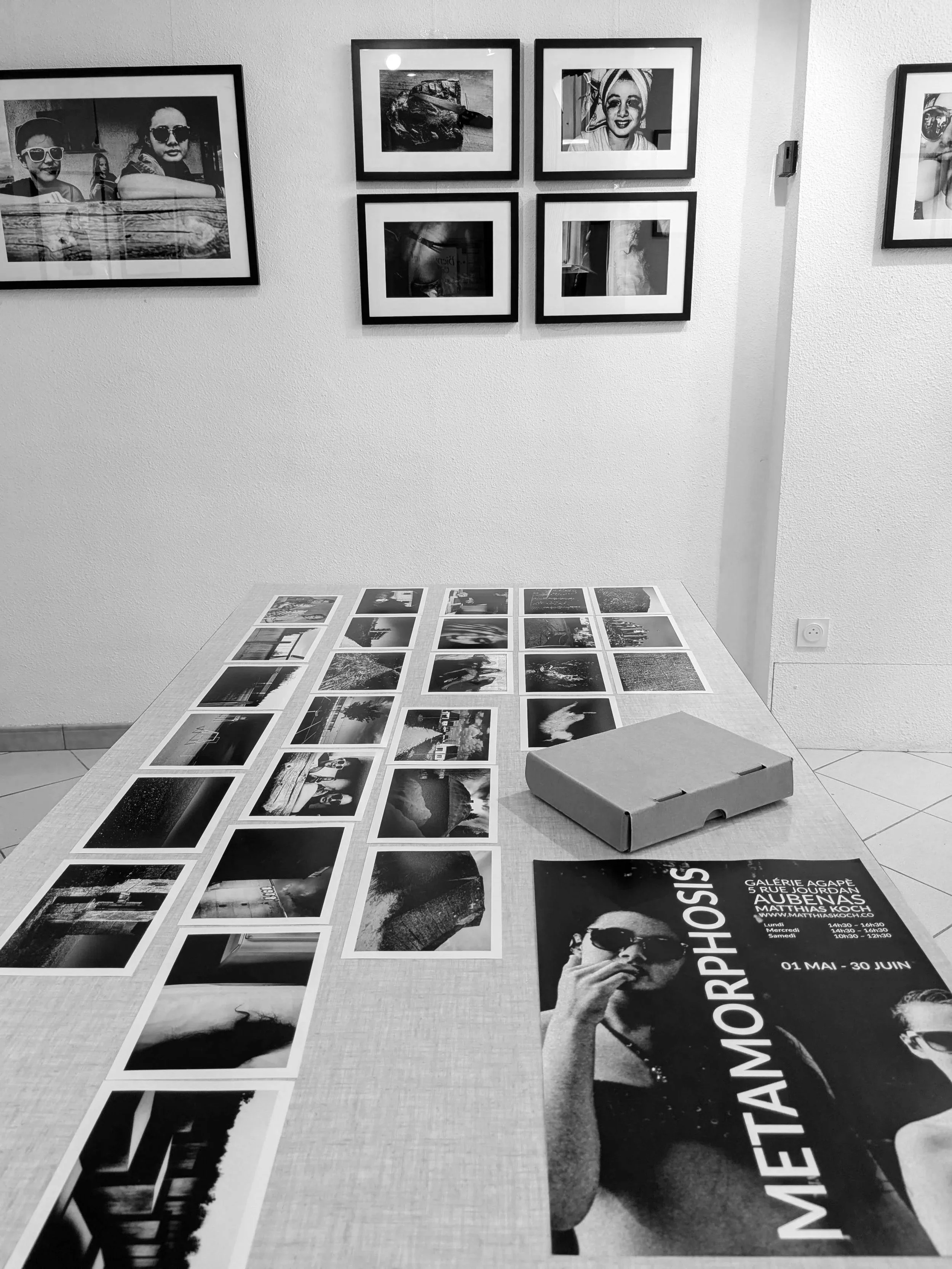
Photographing is accumulating. But a series does not exist in volume — it exists in decision. I have spent years photographing memory, absence, and the fractures of the present. What I have learned is this: the work does not happen in front of the subject. It happens afterwards, alone, in the repeated confrontation with one's own images.
The Edit as an Act of Thought
In my practice, editing is not simply one step among others. It is where the work truly begins — or rather, where it reveals itself for what it really is.
Photographing is accumulating — hours, years, thousands of possibilities. But a series does not exist in volume. It exists in decision. Every image kept is an affirmation; every image discarded, a refusal. This double movement — keeping, rejecting — is what gives a body of work its necessity, its interior tension, its reason for being.
Time as a Condition of Editing
My series are built over the long term. Todtnauberg, Unheimlichkeit, Resonances — none of them emerged from a single session or a single moment of clarity. They revealed themselves through repeated returns to the images, through gradual connections, through removals that opened new coherences. Editing is a form of deferred looking — a dialogue with oneself across time, where the person looking is no longer quite the person who photographed.
This temporal distance is a condition, not a luxury. It allows one to see without the intoxication of the moment, without the fatigue of the session, without the attachment to the circumstances surrounding the act of taking the picture. What seemed strong can turn out to be anecdotal; what had been overlooked can suddenly become central. The image detaches itself from its context of production and reveals itself for what it truly is.
Larraín: The Series as a Living Organism
Sergio Larraín is perhaps the most radical example of this relationship between editing and time. He spent decades reworking his archives — not to exploit them commercially, but because his understanding of what he had photographed continued to evolve. His images of Valparaíso — taken in the 1950s and 1960s — went through very different states of editing at different periods of his life. What he showed at 30 was no longer what he showed at 60. Not because the images had changed, but because he had changed, and his relationship to memory, to childhood, to the city had been transformed.
Larraín spoke of photography as a form of meditation, an almost spiritual practice. Editing participated in the same logic: it was not about selecting the "best" images in any technical sense, but about finding those that resonated with something essential, intimate, sometimes inexplicable. He accepted this irrational dimension in the act of selection, and it is precisely this that gives his work its particular depth — that feeling that every chosen image is there for reasons words alone cannot exhaust.
Moriyama: Editing as Resistance to the Flow
Daido Moriyama occupies a paradoxical position in the history of photography: he is one of the most prolific photographers who has ever worked — tens of thousands of images produced over more than sixty years — and yet his published body of work possesses a striking formal coherence. This paradox is only possible through an editing practice of extreme rigour, all the more remarkable for being almost invisible.
His method is one of deliberate saturation. He photographs continuously, compulsively, as though interrupting the flow risks missing something essential. But it is precisely because the flow is inexhaustible that editing becomes a vital necessity — not to control production, but to give it meaning retrospectively. Moriyama returns constantly to his archives, re-edits them, republishes them in new forms, recomposes books from older material placed in new contexts. The same image can appear in several books carrying radically different meanings depending on what surrounds it.
What his practice reveals is that editing is not a definitive gesture but a repeated one — an endless conversation with one's own archives. There is no "final" version of a body of work; there are successive states, each revealing something the previous state could not see. This conception of editing as an open, never fully closed process resonates deeply with my own experience of working in long series: a series is never truly finished, only momentarily stopped.
Frank: Editing as Subversion
Robert Frank offers a different example still — perhaps the most subversive. When he edited The Americans, he deliberately set aside the "well-made" images in favour of blurred, poorly framed, backlit photographs — images that any art director of the time would have rejected outright. His editing was an act of rupture with the dominant codes of documentary photography in the 1950s. He was not searching for representational clarity but for something more restless, closer to subjective perception, to raw affect.
What is remarkable about Frank is that this editing reflected a worldview, not merely a style. The unease, the alienation, the loneliness he wanted to show in postwar America — these things could not be shown through smooth, well-exposed images. The form of the editing matched the form of the argument. The selection was already an interpretation.
What Editing Reveals About Oneself
What these examples share — beyond their considerable differences — is that editing always ends up revealing something the act of photographing alone could not yet know. Editing is the moment when one becomes aware of what one was truly searching for, even if that was not apparent at the shutter's release.
In my own work, it is often in the editing that I understand the real subject of a series. I thought I was photographing a place; I discover I was photographing an absence. I thought I was working on collective memory; I realise it was a deeply personal memory structuring my choices all along. Editing is a mirror — uncomfortable, often, but necessary.
What I look for in a final selection is not the perfection of each isolated image, but the rightness of what they form together. The order, the silences between images, the breaks in rhythm — all of this produces a meaning that the act of photographing alone cannot anticipate. An image can be stronger in a certain position within the sequence than a technically superior image placed elsewhere. The context that images create for one another is part of their meaning.
Editing as Responsibility
There is finally an ethical dimension to this selection, particularly acute when working with memory and the fractures of the present. To keep an image is to decide it must be seen. This decision is never neutral. It engages a responsibility towards the photographed subjects, towards the historical and social context from which the images arise, towards the viewer who will trust them to grant access to something true.
Setting an image aside can be an act of restraint as much as of formal rigour. Some images are too legible, too explicit — they close down meaning rather than opening it. Others are too fragile, too intimate to withstand the public gaze without betraying themselves. Editing is also the art of knowing what must not be shown.
Editing is, at its core, the place where I answer the question I should have asked before pressing the shutter: why this image, and to say what? But it is precisely because one cannot always answer that question at the moment of taking the photograph that editing is irreplaceable. It is what allows photography to move beyond the gesture of capture and become an act of thought.