You’re looking too quickly to really see.
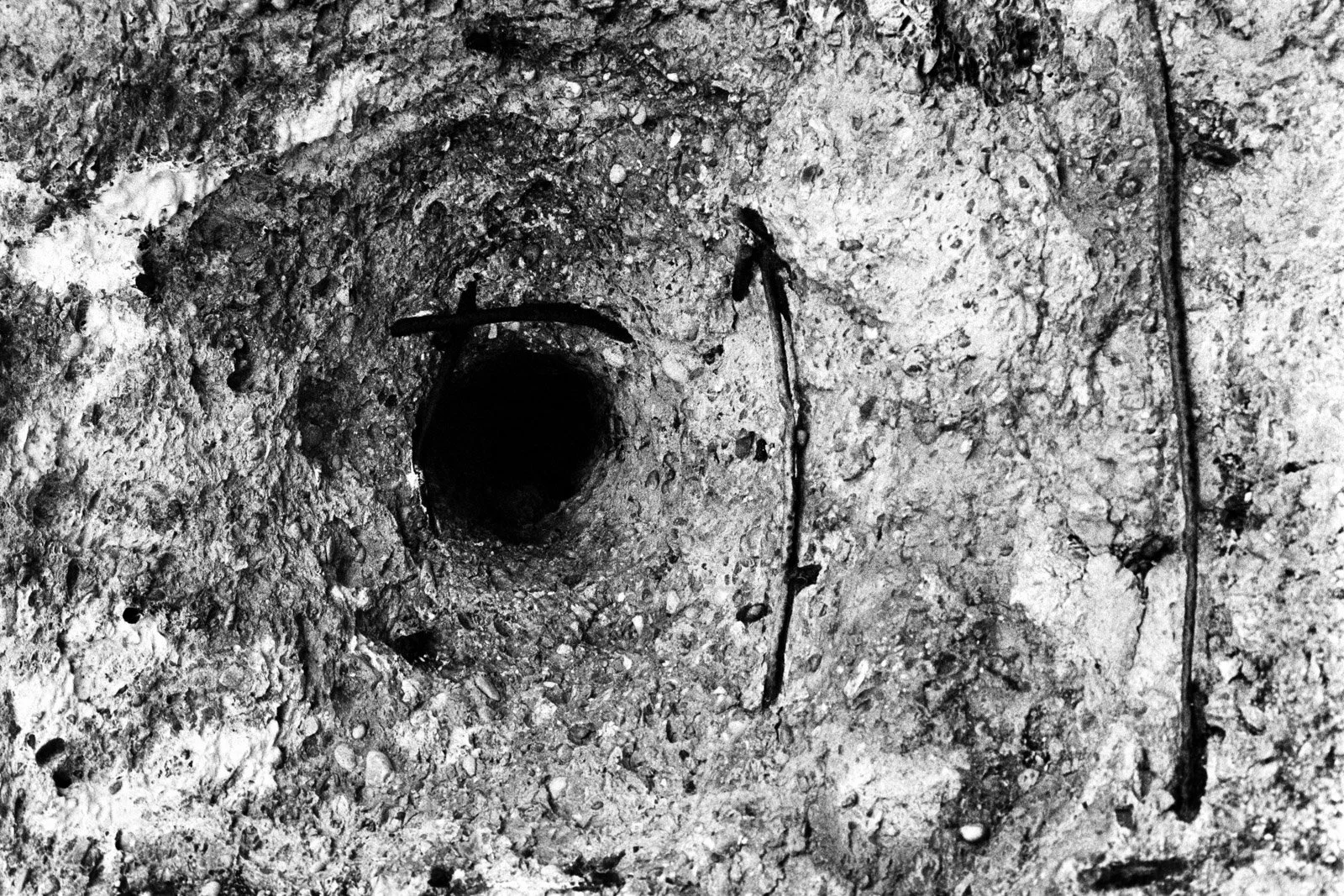
I make photographs that don't give themselves up at a glance. Series that take ten years. Images that ask you to stop — genuinely. In a world that accelerates, this has become a position. Here is why I hold it, and how to read what I do.
I was born in Germany. I have lived in Ardèche for many years. Between these two territories — one weighted with a history I did not live but nonetheless inherit, the other rural, peripheral, strangely shielded from certain pressures — a practice has formed that I could summarize as follows: I photograph what time leaves behind. Not events — their residue. Not things — their echo.
This is not a slogan. It is a working constraint, almost a negative discipline. It forbids me the spectacular image, the decisive moment, beauty that is too immediately available. It commits me to duration — to returning to the same places year after year, to the patient accumulation of images that, taken individually, often seem to amount to very little. But together, they exert a pressure. They produce something that resembles less a demonstration than a haunting. It is that haunting I am trying to build.
I do not look for the light that beautifies. I look for the light that reveals — the light that makes you feel the weight of what has settled there.
The tagline of my website, Not things. Their echo, is often read as a poetic formula. It is first of all an operational instruction. When I arrive at a place — a forest, a threshold, a battlefield, an empty room — my question is not: what is beautiful here? It is: what remains? What, in this place, is not yet the past? What continues to act, silently, on the present?
Inheritance — Günther Anders and the Promethean Shame
The question of German inheritance runs through my work, sometimes subterranean, sometimes frontal. I did not live through the war. I carry no direct guilt. But I grew up inside a culture that long oscillated between two equally unsatisfying postures: silence and confession. Neither suits me. Photography offered me a third path.
The philosopher Günther Anders — born Günther Siegmund Stern, exiled, companion of Hannah Arendt, witness to Hiroshima — named Promethean shame the particular feeling that grips human beings in the face of their own creations: the shame of being inferior to the machines they have produced, of being incapable of fully sensing the reality of what they make and what they destroy. In The Obsolescence of Man, he diagnoses a humanity that can produce the apocalypse without being able to imagine it — that acts at a scale its own sensibility can no longer follow.
This is a thought that touches me directly. To be the heir of a generation that produced catastrophe without being able — or willing — to measure its weight: that is precisely the terrain I explore in the series Todtnauberg. The title comes from the Black Forest village where Heidegger had his hut — and where Paul Celan came in 1967, hoping for a word of recognition that never came. Celan wrote a poem. The absence of speech entered the mythology of European intellectual trauma.
My series departs from there and extends: toward Amsterdam, toward the threshold of the Anne Frank House, toward Athens, toward Verdun. This is not a documentary project. It is an investigation into what these places still hold — into what, within them, continues to exert pressure on anyone willing to stop. My work does not seek catharsis. It seeks to hold this weight inside the frame. Without resolving it. Without dramatizing it either. Simply: leaving it present, opaque, irreducible.
A photograph does not show what happened. It shows what remained — and that is a different truth, harder, more durable.
Resonance — Hartmut Rosa against acceleration
My recent work has been built in dialogue with the thinking of sociologist Hartmut Rosa, and in particular his concept of resonance. Rosa describes late modernity as a condition of generalized acceleration: not only do things move faster, but the very relationship to the world is transformed. The world becomes more and more available — everything accessible, quantifiable, optimizable — and less and less resonant: things stop truly touching us, affecting us, changing us. We manage them. We no longer encounter them.
The series Resonances is built against this logic. It asks: what, today, still possesses the capacity to vibrate at a frequency we can feel? Which places, objects, presences resist total availability? The series also carries a political edge I do not avoid: we are living through a moment of authoritarian resurgence in Europe. My images carry that unease — not as a manifesto, but as a darkness gathering at the edges of the frame.
These images ask time of the viewer. Not effort, not specialized knowledge — simply the disposition to be touched. In a world defined by acceleration, that demand has become almost radical. It may be the most political thing I do: insisting, calmly and without apology, on another speed.
Territory — Ardèche, Europe, chosen margins
Ardèche is not a backdrop. It is an anchor — and a choice. Living far from the centers, far from Paris and Berlin, demands a form of autonomy I consider a working condition, not a handicap. Distance from the usual circuits of validation forces a kind of honesty: you cannot ask whether something will please before asking whether it is true.
This territory also shapes my eye in more concrete ways. The Ardèche landscape — its basalt, its ridgelines, its half-abandoned villages, its strongly marked seasons — has entered my work not as subject but as tonality. There is in this territory a resistance to the picturesque, a roughness, a way of being old without being nostalgic, that corresponds to something in my practice.
And then there is what is being built here collectively. Éditions du Tanargue, a publication rooted in this territory proceed from the same conviction: that serious photographic culture can be built far from the major fairs, that it does not need spectacle to exist, and that slowness is not a lack of means but an ethic.
Writing as parallel practice
I work in parallel on a theoretical writing practice developed in dialogue with the philosopher Claude Molzino. These texts are not commentaries on the photographs — they do not explain them or accompany them pedagogically. They are distinct investigations bearing on the same questions: how can an image carry time? What remains of a place after what defined it has disappeared? What is the status of the trace in a culture of the instantaneous?
They coexist with the photographs in a tension I do not try to resolve — discursive thought and thought through images do not say the same thing, even when they address the same object. That difference is precisely what interests me.